Stay listed. We keep the watch.
Exchanges publish the thresholds that get a token flagged: average spread, holder count, holder assets, cross-venue price gap. VenueMM is a control panel and trading engine — spot market-making software that holds spread, depth and daily volume inside them — measured daily, reported daily, and run on your own accounts with your own keys. Your capital never leaves your exchange.
- Your keys, your capital
- Operators on watch
- Daily compliance report
- Monthly license
Illustration of the panel's ladder view · spread 0.50% · depth budget in force
| No. | Property | Value | Remark |
|---|---|---|---|
| 01 | Venues live in production | 2 | MEXC and LBank — the full stack, running today |
| 02 | Depth band held | ±2% | USDT depth targets in the band exchanges actually check |
| 03 | Foreign orders cancelled by the bot | 0 | It manages your orders only — manual and third-party orders stay |
| 04 | Panel commands on record | 100% | Start, stop, thin, range — auditable history, per operator |
Values describe the current release. VenueMM is software: it does not guarantee volume, price or listing outcomes.
If the venue has a spot API, VenueMM runs on it
One engine on a unified spot API layer (CCXT), so any CEX that exposes standard spot order endpoints is in scope. MEXC and LBank are the venues we run in production today; the rest go live with keys, a venue adapter for the local quirks and a short soak test.
 MEXC
Live · full stack
MEXC
Live · full stack
Spot limit ladder, depth budget, volume policy and range plans — proven on alt listings, at listing-grade depth requirements.
- Depth compliance monitored against the ±2% band
- Selective thin instead of cancel-all
- Cross-venue align with a second book
 LBank
Live · MM API path
LBank
Live · MM API path
Runs on the dedicated market-maker API endpoint with the IP whitelist flow. Same panel, a venue adapter for the quirks.
- MM endpoint plus whitelist onboarding handled
- Order-cap aware ladder refresh
- Same commands, same audit history
Support matrix
| Venue | Status | Coverage note |
|---|
What “supported” means: the venue exposes spot limit orders, cancel by id, open orders, balances, order book, tickers and — where available — my-trades. That is the whole requirement: any exchange with those endpoints can run the full VenueMM stack, and the venues below are examples, not a limit. DEX and perpetuals-only venues are out of scope for v1.
Depth where the exchange looks
Listing teams are measured on USDT depth inside ±2% of mid. When mid moves, most bots pile up orders until the exchange caps them. VenueMM runs a hard depth budget instead: as the band slides, stale levels leave and fresh ones enter — the band stays filled and your order slots stay free.
- Budgeted depth per side, not an unbounded order pile
- Selective thin protects the band and your manual orders
- Compliance view shows the band filled vs the target
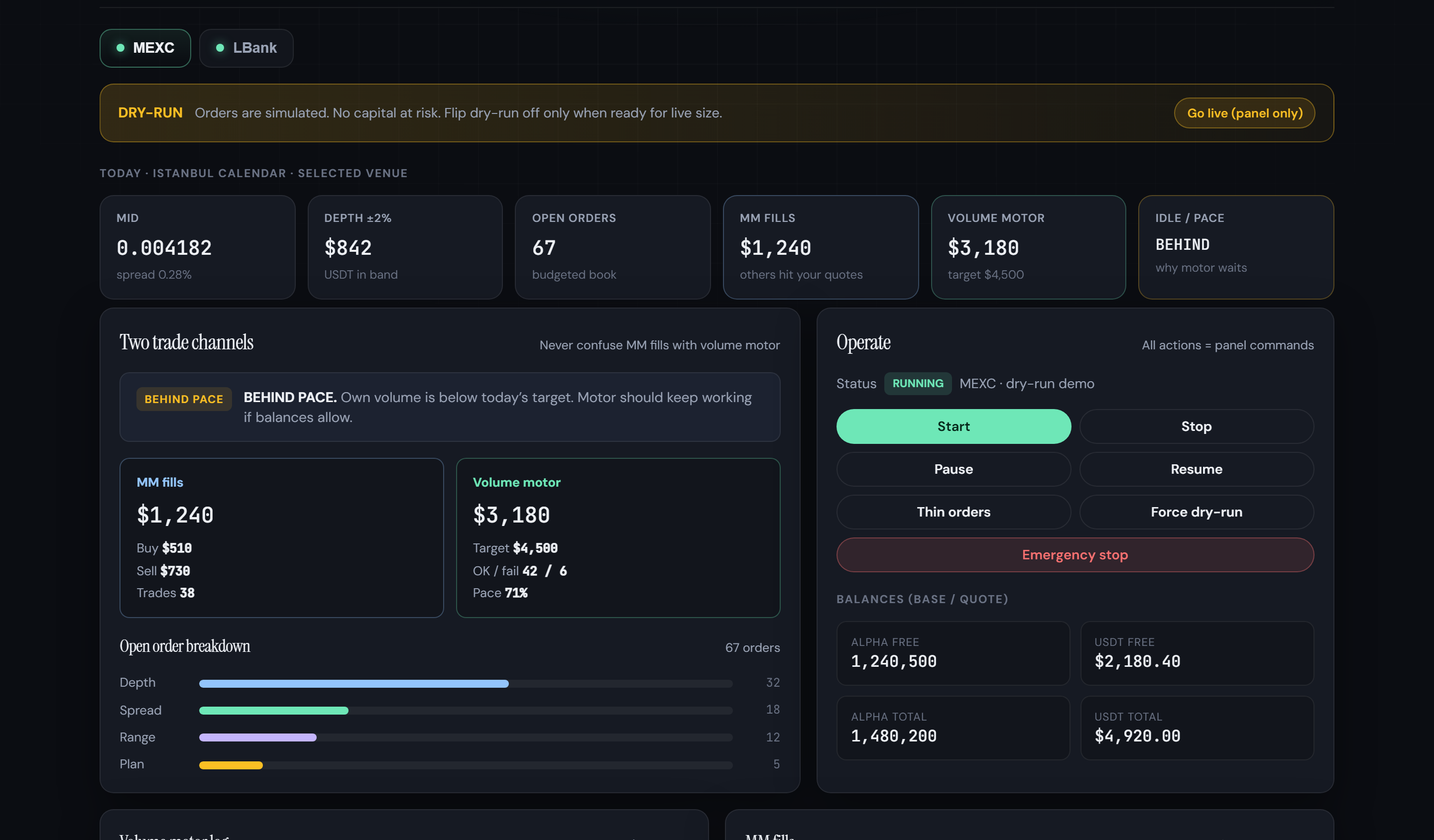
One screen, the whole desk
Balances, open orders, fills, depth compliance, running plans and command history — with a stop button that reaches every venue at once. Operators work in commands, not in scripts.
Four layers: book, volume, watch, panel
The same core we run live for listing-grade spot market making. Every line below is a panel command with a limit and a log entry.
1 · The book — quotes and depth
Spread & quote ladder
Multi-level bid and ask around mid. Spread, level count, size and refresh — smart update, never wipe-and-repost.
Listing depth (±2%)
USDT depth targets in the audited band, held by a hard budget so order caps never bite mid-session.
Order plans & ranges
Deliberate ranges or percent-of-free-balance plans the live ladder will not auto-kill, with maintain and refill rules.
Selective thin
Free open-order slots without cancel-all. The depth band and your manual orders are protected. Buy side, sell side or both.
Inventory skew
Long base or long quote, the ladder biases back toward balance — always inside your own min and max rules.
Cross-venue align
Two books track each other by price gap: pull the cheap side up, ease the rich side, limit arbitrage bleed.
2 · Volume programs
Depth alone does not carry a listing: exchanges and traders both read turnover. VenueMM runs volume as an explicit program — a daily target, a price band it may never leave, per-account caps, and a record of every leg. Targets are yours to set; the engine keeps them inside the policy you approve.
Volume motor
Daily minimum and maximum, or a variable daily goal, counted on your own bot activity per calendar day — never inferred from the exchange's 24h figure.
Price band guard
Every program runs inside a configured band, so turnover never comes at the price's expense. Outside the band the engine stands down instead of chasing the target.
Peer account fleet
Separate accounts under one panel produce peer turnover, each with its own keys, its own daily cap and its own line in the audit log.
Movement plans
Stepwise buy and sell campaigns for directed flow: modelled first, then run — tracked, pauseable and logged, never silent random noise.
Formation rehearsal
Simulate a candle pattern on the book, review it on screen, then run it coordinated with spread and depth so the chart never fights the market making.
Operator takes
Third-party liquidity on the book is visible and can be taken deliberately (IOC) by a human operator. Never automatic.
3 · The compliance watch
The thresholds that get a token flagged are published, measurable and checked on a rolling window. We measure them on your pair every day, raise the alarm long before the exchange does, and hand you a report you can forward to the listing team. This is the part nobody else sells by name.
Threshold monitoring
Average daily spread, rolling windows, holder counts and cross-venue price gap tracked against the exchange's published limits — with headroom shown, not just a pass mark.
Daily compliance report
One page per day: where each measured value sat, what the engine did, and what an operator changed. Forwardable to the listing team as-is.
Alarms before the warning
Thresholds are measured over days, so drift is visible early. Telegram alerts fire on approach — not after the exchange publishes a notice.
Someone is awake
A bot dying at 03:00 is not a software problem, it is a staffing one. Watchdog, on-call operator and a named contact who answers.
Bounded by policy
Everything the engine may do is capped in writing: price band, per-day and per-account limits, operator permissions. Outside the band it stands down.
4 · Control panel and risk
Ops visibility
Balances, open orders, fills by source, depth compliance and command history — who did what, when, and why.
Risk & emergency stop
Stop-loss and peak drawdown, minimum free USDT and base, maximum position, and one stop button across venues.
Alerts
Telegram and webhooks for stop hits, low balance, order-cap errors, a bot going down or a large venue gap.
Dry-run & paper
Run the same commands with no capital at risk, and keep a paper path for regression before production.
Your keys, your custody
Trade-only API keys on your own accounts. We never custody funds, and the bot never cancels a foreign order.
The bot is not the job. The watch is.
Free bots exist and they work — until the book gaps at 03:00 on a Sunday. An outsourced desk takes that problem away and your keys with it. We are the third option: software you run with the keys left in your hands, and operators who keep the watch.
| Self-hosted bot | Outsourced MM desk | VenueMM | |
|---|---|---|---|
| Custody of trading funds | Yours | Loan or transfer to the desk | Stays on your exchange account |
| Who watches at 03:00 | You do | They do, silently | Named operator, watchdog, alerts to you |
| Threshold compliance | Not measured | Monthly report, their numbers | Measured daily, reported daily |
| Setup and tuning | Servers, strategy, uptime — all yours | Theirs, then opaque | Ours, on policy you approve |
| Cost shape | Free code, your salary | Retainer plus token options | Flat monthly fee, published |
| Exit | Stop the process | Unwind negotiation | Revoke the API key |
Four steps from keys to a live book
The full ops manual ships with your license. On the setup call we read your pair and your listing terms together.
- 01 Connect Exchange API keys with trade on and withdraw off. Your keys, your account.
- 02 Set policy Spread, depth targets, inventory limits, activity caps, price band and risk limits.
- 03 Dry-run, then live Validate the commands with no capital at risk, then go live at small size.
- 04 Operate from the panel Start, pause, thin, set a range, emergency stop — every action on record.
Monthly, published, flat
Settlement in USDT on BNB Smart Chain. You trade with your own exchange keys — we never custody your trading funds.
One license covers one project. Every pair in a plan is a pair of your own token — say TOKEN/USDT and TOKEN/USDC across your venues. A second token needs its own license.
Starter
$599 /mo
- 1 project · 1 exchange · 1 pair
- Full book: spread, depth budget, plans, thin
- Volume motor with price band
- Ops panel · dry-run · alerts · email support
Pro
$1,199 /mo
- 1 project · 2 exchanges · up to 2 pairs
- Everything in Starter
- Account fleet · cross-venue align
- Stepwise programs · priority support
Scale
$2,499+ /mo
- 1 project · 3–5 exchanges · 6–12 pairs
- Everything in Pro
- Formation rehearsal · operator takes
- SLA · dedicated channel · listing workshop
Unlimited
$6,999 /mo
- 1 project · unlimited exchanges and pairs
- Everything in Scale
- Multi-operator roles · consolidated reporting
- Named engineer · onboarding for new venues
| Plan comparison | Starter | Pro | Scale | Unlimited |
|---|
The five we always get
01 Do you ever hold our funds?
No. VenueMM is software running against trade-only API keys on your own exchange accounts. Withdrawal permission is never required, and revoking the key ends everything instantly.
02 Is what the engine does permitted?
That is set by your exchange agreement and your own legal and compliance review, not by us. VenueMM's job is to make the policy explicit and enforceable — caps, bands, permissions per operator — and to log every action so you can evidence what ran.
03 What happens when the price gaps?
The depth budget re-centres on the new mid: stale levels leave, fresh levels enter, and inventory rules bias the ladder back toward balance. Stop-loss, drawdown and minimum-balance limits can halt everything, on every venue, in one command.
04 Our venue is not on the list.
If it exposes standard spot order APIs, it is an adapter — minimum notional, client order ids, rate limits, self-trade rules — plus a paper soak test before live. Tell us the venue and the pair on the form and we will confirm the path.
05 How does payment work?
Prices are in USD and settled one-to-one in USDT (BEP-20) on BNB Smart Chain — no conversion, no exchange-rate risk. You receive an invoice with the exact amount and the wallet address; the panel activates once the transfer confirms on-chain. Monthly or yearly.
Start VenueMM
Leave a plan, an exchange and a pair. We come back with the venue path, the setup checklist and the USDT invoice — then your panel goes live.
One license, one project: all pairs run on your own token. Keys never need withdrawal rights, and the setup call takes 30 minutes.
VenueMM is a software license, not a trading service, an investment product or financial advice. We do not custody customer funds and do not trade on our own behalf on your pair. Prices are quoted in USD and settled one-to-one in USDT (BEP-20) on BNB Smart Chain. There is no setup fee. Nothing here guarantees volume, price, liquidity or a listing outcome. Compliance with your exchange's terms of service, market-conduct rules and the law applicable to you remains your responsibility, and configuration limits are yours to set and review. Not affiliated with, endorsed by or acting for any exchange named on this page; all marks belong to their owners.